Think about everything that goes down your drains in a year. There’s grease off the frying pan, soap scum, bits of food, plus the minerals in the water itself, and a little of each one stays behind every time. You never see any of it, of course, not until some morning when the kitchen sink won’t empty or the basement drain starts making that gurgling noise. A plunger or a snake will get you through the clog, and we’re not knocking either one, but whatever built up on the pipe walls is still sitting there afterward, which is the whole reason hydro jetting exists.
So what is it, exactly? It’s a professional drain cleaning method, and the short version is that we send high pressure water through your pipes to scour the insides and flush all that debris out. Our crews at PF Plumbing reach for hydro jetting when a clog is being stubborn, or when a drain or sewer line needs its full flow back, and we do it in homes all over Winston-Salem and the Piedmont Triad. Below we’ll get into how it works, when you’d actually need it and what separates it from the other drain cleaning services you’ve probably heard of.
Key Notes
- Sewer overflows happen a lot more than people realize. The EPA’s estimate is at least 23,000 to 75,000 sanitary sewer overflows in the United States every year, and plenty of those began as a blockage slowly building up in a pipe.
- Want to guess the top cause? An EPA report to Congress found it was grease, behind 47% of the sewer blockages that got reported, and that’s the exact kind of buildup hydro jetting is built to get rid of.
- Of the U.S. sewer overflows that get attributed to blockages, tree roots contribute to roughly one-quarter.
What is hydro jetting?
The simplest way we know to explain hydro jetting is that it’s a pressure washer for the inside of your plumbing. Where other methods just break through a clog and call it a day, this one cleans the entire diameter of the pipe.
How hydro jetting works
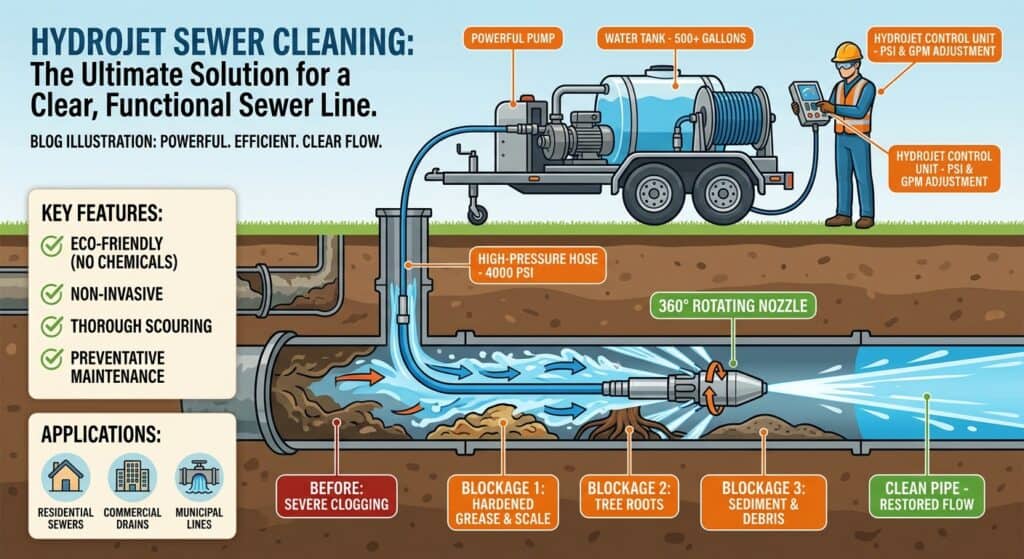
First we find a way in, which is usually a cleanout (though any good access point will do), and feed a flexible high-pressure hose down into your drain line. The business end of that hose has a specialized nozzle on it. Part of the water shoots straight ahead and breaks up the clog, and the rest comes out of several jets pointing backward, which is clever, because those rear jets drive the hose further down the line and scrub the pipe walls at the same time. Then, as we slowly pull the hose back, the water carries all the grease, sludge and debris down the line and out to the sewer or the septic system.
The equipment behind professional hydro jetting
Residential hydro jetting machines typically deliver water at around 1,500 to 4,000 PSI, and where we set it in that range depends on the pipe’s size and condition. We also carry different nozzles, because each kind of job calls for its own:
- A spinning nozzle when the problem is grease
- A penetrating nozzle for the hard blockages
- A root-cutting head, which is the one we use in sewer lines
All of this is commercial-grade equipment, and it takes training to use safely, which is the honest reason hydro jetting is a professional service and not a rental-store project for a Saturday.
Hydro jetting vs traditional drain snaking
A drain snake (some people call it an auger) is a metal cable that spins its way through a clog to break it up, and for a simple clog close to the drain it’s a great tool. Its limitation is that a snake usually opens only a small channel through the blockage and leaves most of the buildup sitting on the pipe walls, so the clog often returns. Hydro jetting cleans the pipe wall to wall, and that’s what makes it the better choice for recurring clogs and main sewer lines. Plenty of PF Plumbing drain calls start out with a snake and then move to hydro jetting once the camera shows heavy buildup in there.
How hydro jetting cleans your pipes
A proper hydro jetting service follows a clear process, and we don’t skip steps in it, since each one protects your plumbing and makes sure the job really does solve the problem.
Camera inspection before the job
Before a drop of water goes into the line, the plumber runs a small waterproof camera through the pipe. That video shows us what’s causing the blockage, where it is, and whether the pipe is in good enough condition for hydro jetting to begin with. A camera inspection also turns up problems that might need repair, like cracks, root intrusion or the sagging sections we call bellies.
Scouring grease, scale and debris from pipe walls
With the nozzle in the line, the high pressure water cuts through whatever is coating the pipe walls, and that coating is usually some mix of grease, soap scum, mineral scale, food waste and sludge. Since the water reaches every side of the pipe, hydro jetting restores it close to its original diameter, which is a very different result from poking a hole through the clog.
Flushing everything out of the line
While the plumber reels the hose back in, the steady flow of water flushes the loosened debris down the line and out of your plumbing system. Many plumbers (us included) finish with a second camera pass to confirm the pipe is clean and flowing freely, and that way you get to see the before and after for yourself.
Signs your drains need hydro jetting
We’ll be straight with you, not every clog calls for hydro jetting. When you’re seeing the signs below, though, it usually means the buildup runs deeper than a plunger or a snake is going to reach.
Recurring or stubborn clogs
When it’s the same clog coming back every few weeks or months, the problem likely isn’t one single blockage at all. What you’ve got is buildup along the pipe that keeps catching debris as it goes by, and hydro jetting removes that buildup so the clog finally stops coming back.
Slow drains throughout the house
One slow sink usually points to a local clog, and that’s not a big deal. It’s a different story when several drains are slow at once, or when water backs up into the tub as you flush the toilet, because then the problem is often in the main sewer line. Main line clogs are among the most common reasons homeowners call us for hydro jetting.
Gurgling, odors and sewer backups
Gurgling toilets, sewer smells coming from the floor drains and wastewater coming up through the lowest drain in the house are all signals of a blockage in the main line. Of those, a backup is the most urgent sign, since sewage in the home is a health hazard. We’d much rather you schedule hydro jetting at the first sign of trouble, because it costs far less than cleaning up after a backup.
Benefits of hydro jetting for your home
It’s true that hydro jetting costs more upfront than basic snaking. What you’re paying for is results that tend to last much longer.
A deeper clean that prevents future clogs
Hydro jetting removes buildup from the entire pipe, so there’s much less left behind for new debris to stick to. We’ve had many homeowners go a year or longer without problems after hydro jetting a line that used to clog every few months, and when you add up the emergency calls they didn’t have to make, that’s real savings.
Clears tree roots without digging
Roots go looking for water, and a sewer line is full of it, so if there’s a small crack or a loose joint anywhere, they’ll find their way in. With a root-cutting nozzle we can clear roots from the line without digging up your yard. We won’t pretend hydro jetting is a permanent fix for a damaged pipe, because it isn’t, but it restores flow and buys you time to plan a repair if the camera shows the pipe needs one.
Chemical-free and safe for the environment
Chemical drain cleaners can damage pipes, and on top of that they only dissolve part of a clog. Hydro jetting uses nothing but water, which means no harsh chemicals end up in your plumbing, in your septic system or in the surrounding area.
Is hydro jetting safe for your pipes?
We hear this one a lot, and it’s a fair question given how high the water pressure is. The short version is that when a trained plumber does the work, hydro jetting is safe for most residential plumbing systems.
Pipe materials that handle hydro jetting well
PVC, ABS and cast iron pipes that are in reasonable condition all handle hydro jetting well. It isn’t one setting for everybody, either, since the plumber adjusts the pressure and the nozzle to match the pipe’s material, diameter and age.
When hydro jetting isn’t the right choice
There are some pipes that may not be good candidates for this cleaning method, and we’d put these on the list:
- A pipe that’s already cracked, or one that has collapsed
- Pipe that has gotten badly corroded
- The fragile materials, meaning old clay or Orangeburg pipe
When that’s what we find, the plumber will recommend a gentler cleaning method, or a sewer line repair first. It’s also why the camera inspection matters so much.
Why hydro jetting should be done by a professional
In the wrong hands, high pressure water can injure skin and damage pipes. A licensed plumber knows how to inspect the line, how to choose the right settings and how to spot the problems that need more than a cleaning. PF Plumbing’s hydro jetting service includes the camera inspection, along with the expertise to recommend the right fix for your pipes.
Frequently asked questions
What is hydro jetting in plumbing? It’s a drain cleaning method, and the way it works is that high pressure water gets sent through a specialized nozzle so it can scour the inside of the pipes and flush away grease, scale, debris and roots. Some people call it hydro plumbing or water jetting, and it’s all the same thing.
Is hydro jetting better than snaking a drain? Usually yes, at least for recurring clogs and main sewer lines. A snake only opens up a small channel through the clog, whereas hydro jetting cleans the entire pipe wall and takes out the buildup that makes clogs return.
Can hydro jetting damage pipes? Not when a trained plumber is doing the work and the pipes are in reasonable condition, and that covers most pipes. The ones that may not be good candidates are cracked, collapsed or made of fragile materials, so we always do a camera inspection first.
Does hydro jetting remove tree roots? Yes, it does. There’s a root-cutting nozzle made for exactly that, and it clears roots out of a sewer line with no digging. Keep in mind that if those roots are getting in through a damaged pipe, a repair may be needed for a long-term fix.
How often should drains be cleaned this way? Most homes only need hydro jetting when problems appear. It’s different for homes with recurring clogs or large trees near the sewer line, which may benefit from regular cleaning, and in that case your plumber can recommend a schedule based on what the camera shows.
So if your drains keep clogging, or the main line is backing up, or you’d just like to know what’s going on inside your pipes, PF Plumbing can help. When we do hydro jetting, the camera inspection comes first, then the cleaning, and you end up with clean pipes that drain freely, plus our honest take on which plumbing solutions actually make sense for your home. We cover Winston-Salem, Clemmons, Kernersville, High Point and the Piedmont Triad around them. Call us today and we’ll get your drain services on the schedule, and if it’s a backup that can’t wait, our 24/7 emergency team picks up day or night.